
The Patients Using AI to Pick a Doctor Are Not the Ones You Think
Ask most practices who they think is using ChatGPT to research a doctor and you get some version of the same answer. Younger patients. The ones who grew up with it. Which makes it a problem for later, and later is a comfortable place to put things.
The data says the opposite, and not by a little.
Adoption is highest at 45 to 60
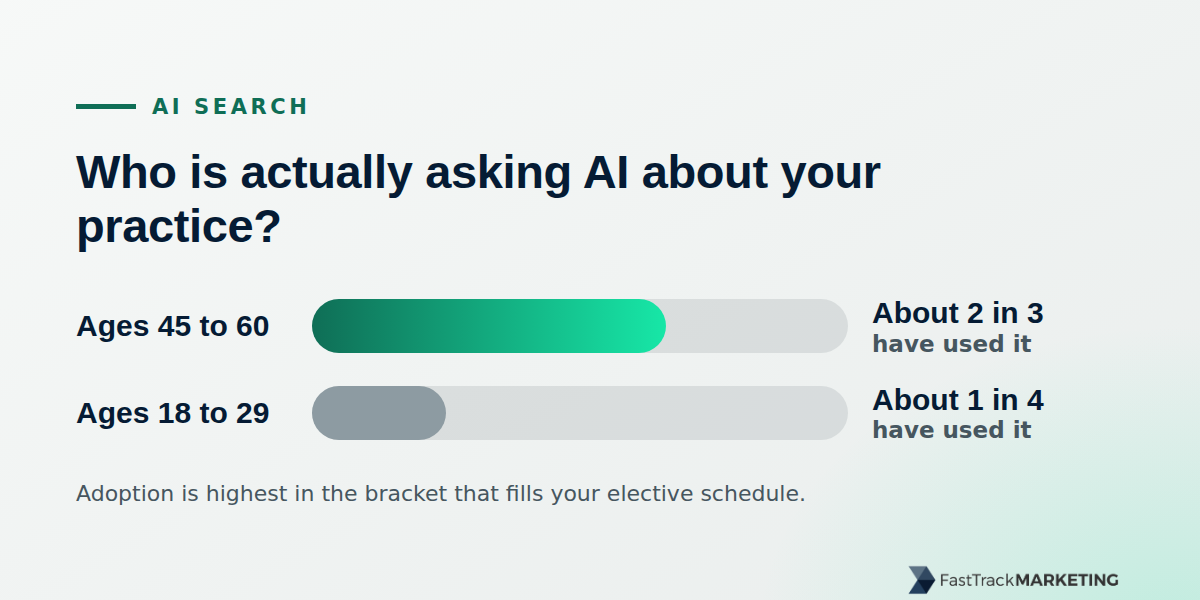
Roughly two thirds of 45 to 60 year olds have used an AI tool to look into a provider. The lowest usage of any adult age group is 18 to 29, at around a quarter.
Read that against your own schedule for a second. In eye care, 45 to 60 is not a fringe segment. It is cataract evaluation. It is presbyopia correction. It is the dry eye patients who have been managing it for a decade and are finally doing something about it. It is, for a lot of practices, most of the elective book.
It is also the group with the most reason to behave this way. They have the procedure decision in front of them, they have the money to make it, and they have enough experience of researching things online to be tired of doing it the slow way. An AI tool that reads forty pages and hands back a short answer is solving a problem they actually have.
The part that should be uncomfortable
Around two thirds of people who have looked up a practice this way came across something wrong.
Not wrong in an interesting way. A phone number that no longer rings. Hours that changed two years ago. A location you closed. A provider who left. Occasionally something a practice would consider close to defamatory, assembled out of a stale directory listing and a confident tone.
And the quieter failure, which is more common than the errors: nothing wrong at all, just a description so generic it could be any practice within thirty miles. Comprehensive eye care, experienced team, state of the art technology. All true, and all useless to somebody trying to pick.
Nobody calls to tell you about either one. There is no form submission that says “I read something about you and went elsewhere.” This is a category of loss that does not appear in any report you currently receive, which is exactly why it can run for years.
Why “we will deal with it later” is the expensive answer
If the users really were 22 year olds, later would be fine. A 22 year old is not scheduling cataract surgery, and by the time they are, a practice would have had twenty years to catch up.
But the people doing this are the people on your surgical schedule for the next quarter. Later is not a different cohort. Later is the same patients, after they have already looked.
There is a second reason waiting is costly, and it has to do with how these tools work. They are not reading your website in real time and forming a fresh opinion. They are largely assembling a summary out of what has already been published about you across directories, aggregators, listings and third party profiles. Which means what they say about you today reflects the state of those sources over a long stretch of time, and changing the sources does not change the answer overnight. The lag cuts both ways, and it is the reason this is not a thing you can fix in the week before it matters.
One thing to do this week
Open ChatGPT, or Gemini, or whatever your patients are most likely to use, and ask it the question a patient would actually ask. Not your practice name. Something like “who is the best cataract surgeon in [your city]” or “where should I go for LASIK near [your area].”
Then read what comes back honestly. Are you in it at all? If you are, is anything in the description wrong? And if nothing is wrong, does any of it say something a competitor’s entry does not?
Whatever you find, write it down. It is the closest thing to a baseline you have, and in six months you will want to know what it looked like today.
One caution, because it is the most common mistake people make after running this for the first time. Do not draw a conclusion from a single answer. Run the same question a few times and you will likely get a different set of practices each time, which tells you something important about how much weight any one result deserves.
You cannot edit it, which is not the same as being stuck
There is no dashboard, no support line, and nothing to log into. That is genuinely different from every other channel a practice manages, and it is why the first reaction is usually to decide there is nothing to be done.
There is. You cannot change what these tools say. You can change what they read, and most of what they read is material you already control or could correct this month. The work is unglamorous and it is largely the same work that keeps the rest of your marketing honest, which is probably the most encouraging thing in this post.
Is AI Recommending Your Practice? is live Thursday, September 24 at 12pm MT. Elaine Honold, our COO, is covering what actually decides whether an answer engine names your practice, how to tell whether any of the work is landing, and five things you can do the following Monday that cost nothing. Free, one hour, and everyone who registers gets our AI Readiness Checklist. Save your spot.
Or if you want to see where your practice stands right now beside your top three competitors across search, local, and AI tools, a Digital Visibility Assessment with Jonna does exactly that. Twenty minutes, free, and you leave with a prioritized list.