

Which Paid Ads Should Your Practice Actually Run?
Most practices come to paid advertising with the wrong question. They ask whether they should be on Facebook, or whether TikTok is worth trying, or whether that rep who keeps calling about connected TV is onto something.
The format is not the decision. The decision is where the patient is when the ad reaches them, and every format exists to do a different job at a different point in that journey. A practice that understands this stops buying channels and starts buying outcomes.
Here is how the six formats actually break down, with an example of each, and how to sequence them when you are not sitting on an unlimited budget.
Search Ads: Start at the Bottom of The Funnel
Search ads are the ones patients do not experience as advertising. Someone types “LASIK Boise” or “cataract surgeon near me,” and your practice appears above the organic results. They have already decided they want the procedure. They are shopping for who performs it.
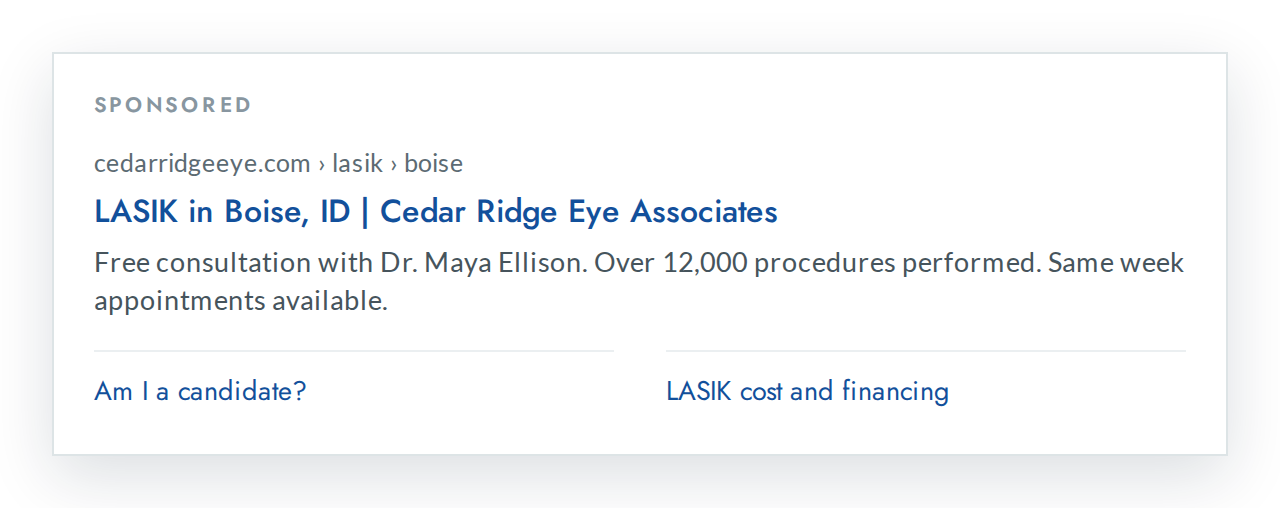
This is the highest intent traffic you can buy, and it is priced accordingly. Competitive refractive markets can run well past fifty dollars a click. It still tends to be the best money a practice spends, because the person clicking is weeks or days from booking, not months.
Search ads also solve a timing problem. SEO is the better long term investment, but rankings take three to six months to move. Paid search puts you at the top of the page tomorrow while the organic work compounds underneath it. Practices that run both usually find the combination outperforms either alone, because you occupy more of the page for the same query.
Start here. If your practice can only fund one thing, fund this.
Contextual Targeting, and Why Retargeting is Off the Table
Retargeting is the one every vendor pitches, so it is worth knowing what it is and why you cannot have it. The idea is simple: a pixel on your site builds a list of people who visited, and you show ads to that list afterward. In most industries it produces the cheapest conversions in the account, because you are not introducing yourself, you are reminding someone who was already interested.
Healthcare does not get to use it. Google’s personalized advertising policy treats health as a sensitive interest category, and that explicitly includes invasive procedures, cosmetic surgery and the treatment of chronic conditions. Advertiser-built audiences, which is to say your data segments, Customer Match, lookalikes and audience expansion, cannot be used to promote anything in those categories. A site visitor list from an ophthalmology practice is exactly that kind of audience. It is not a matter of building the list more carefully or keeping it to general traffic. The feature is closed.
Meta’s policies land in the same place. Plenty of practices run it anyway until an account gets flagged, which is a strategy right up until the morning it is not.
What you can do instead is contextual targeting, which is the older idea and is having a deserved comeback. Rather than following a person, you buy the page. Your ad appears alongside content about vision, aging, screen fatigue or eye health, on the reasoning that someone reading a dry eye article is a reasonable person to reach. Nobody is tracked, no list is built, and there is nothing to get your account suspended.
It targets less precisely than retargeting would, so expect a higher cost per consult. It also sidesteps the compliance problem entirely, which is worth a great deal in this specialty, and it works on the platforms that have been quietly tightening health targeting every year.
The other legitimate way to reach someone a second time is opt-in email and SMS. If a patient gives you their address or number and agrees to hear from you, you can follow up directly. That consent is the whole ballgame, and it is why the form on your consult page earns its keep.
Social ads: Create Demand That Was Not There
Nobody wakes up searching for a procedure they do not know they are a candidate for, and this is where social earns its place: refractive lens exchange, cosmetic oculoplastics, premium IOL upgrades. Procedures with a visual result and a patient who has been quietly unhappy for years.
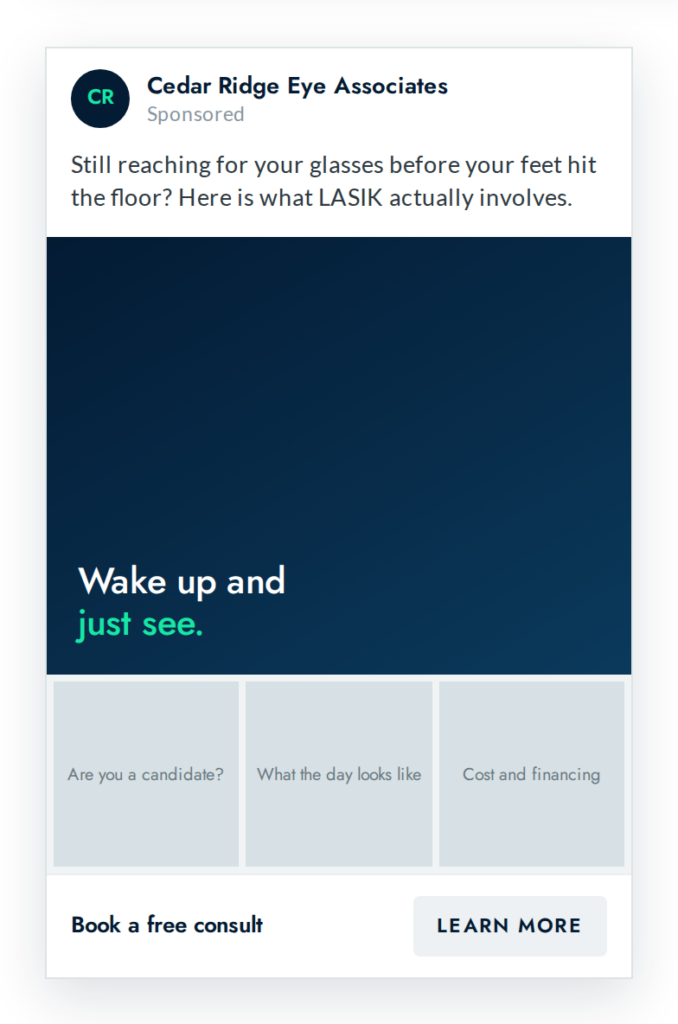
Carousel formats suit a practice particularly well, because they let you walk through candidacy, recovery and cost in a single unit rather than hoping one image carries all three.
Two constraints to build around. Meta prohibits before and after imagery in ads, which removes the single most persuasive asset most practices own, so plan on patient stories and surgeon explanation instead. And the same audience restrictions apply here, so no custom audiences, no lookalikes and no list of past patients. You are reaching broad audiences and letting the creative do the qualifying rather than the targeting.
Video ads: Answer the Fear
Video is the answer to the objection you cannot overcome in text. Nearly every refractive patient is afraid of the procedure, and no landing page paragraph has ever fixed that. Ninety seconds of your surgeon explaining what actually happens, in their own voice, does more than any headline.
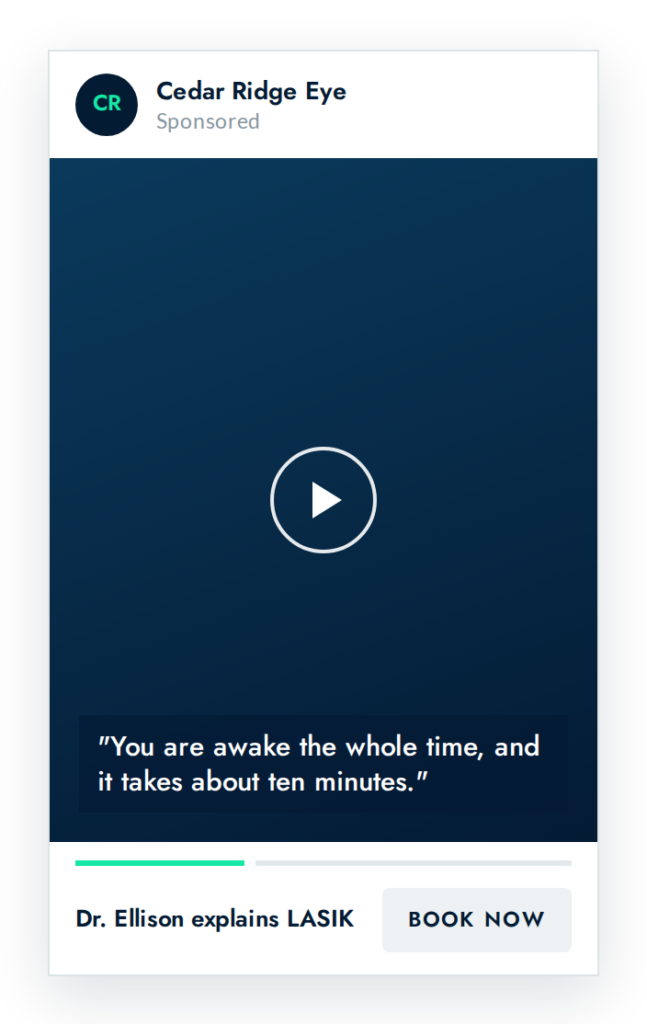
Build for sound off. Most of this gets watched muted in a waiting room or a checkout line, so the message has to survive with captions alone. Put the substance in the first three seconds, because that is the whole audition. And use your actual surgeon rather than a stock actor, since the face in the video is the one the patient is deciding to trust.
Display Ads: Awareness, Carefully
Display ads are banners across the web. Cheap impressions, low intent, and easy to overspend on.
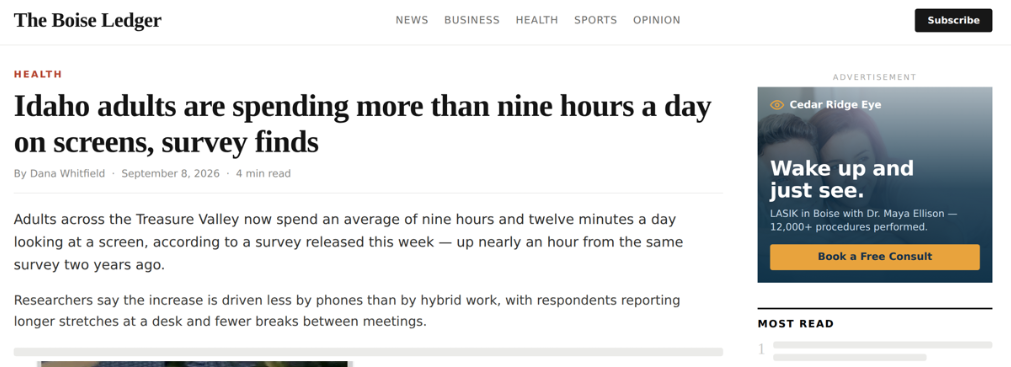
They earn their place for awareness in a market where nobody knows your name yet, and as the place contextual buys actually run. Local news and weather sites punch above their weight for a practice, because the audience is geographically exactly who you want. As a standalone demand generator for a surgical practice, display rarely pays.
Native ads: Build Trust Instead of Clicks
Native ads are sponsored content formatted to match the publication around it. A local news site runs your piece on whether that eye irritation is dry eye or screen time, bylined to your practice.
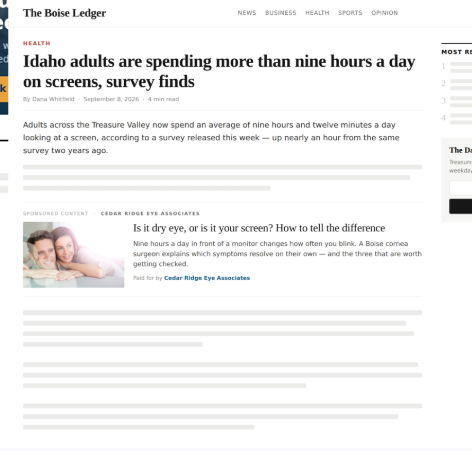
It works because it does not arrive looking like a sale. Native is the slowest of the six to show a return, and the most durable. It is also the format most likely to get picked up and cited by AI search tools, which is becoming its own reason to run it.
The Rules Healthcare Plays By
Every format above comes with constraints that do not apply to a restaurant or a law firm. The platforms enforce some of them, your state medical board enforces others, and the board rules are frequently stricter than anything Google or Meta will flag for you.
Do
- Target by geography and search intent, which is where someone is and what they typed
- Use contextual targeting, which buys the page rather than following the person
- Get written authorization before using any patient photo, name, or testimonial
- Check your state medical board’s advertising rules, which are often stricter than the platforms
- Substantiate every claim with credentials, volume, and outcomes you can actually document
Do not
- Count on retargeting or any advertiser-built audience. Google prohibits your data segments, Customer Match, lookalikes and audience expansion for anything in a sensitive health category, which includes cosmetic and invasive procedures
- Upload patient lists to build a Customer Match or lookalike audience
- Put marketing pixels on patient portals, intake forms, or scheduling pages
- Use superlatives like “best,” “safest,” or “painless,” or anything that promises a result
- Run before and after photos without consent and the appropriate disclaimers
- Assume your web developer set the tracking up compliantly. Verify it yourself
How to Sequence the Budget
If you are building from nothing, in this order:
- Search first, on your highest margin procedures only
- Contextual second, on the local publications your patients already read
- One demand generation format third, chosen by what you are actually trying to grow
- Everything else only after the first three are profitable and maxed out
The mistake we see most often is a practice running all six at fifteen percent each, learning nothing from any of them, and concluding that paid advertising does not work for eye care.
Measure Consults, Not Clicks
Every one of these formats will produce a report full of impressions, clicks, and cost per click. None of those numbers tell you whether the schedule filled.
- Cost per booked consult and cost per booked surgery, broken out by format
- Organic and paid kept separate, so search ads do not quietly take credit for your SEO
- Call tracking, because in this specialty the phone still does most of the closing
- Ask every new patient how they found you. No attribution software will ever beat the front desk
- Ignore total sessions. Traffic climbs when an education article gets shared three states away, and that is not a patient
The Short Version
Search ads catch the patients already looking for you. Contextual placements reach them beside the content they are already reading, since following them around is not an option in this specialty. Social, video, display, and native create demand that did not exist yet, at a higher cost and on a longer timeline.
Run them in that order, measure them against booked procedures, and the question of whether you should be on Facebook answers itself.
Fast Track Marketing builds and runs search and paid media programs for ophthalmology and vision correction practices. If you want a read on where your current spend is working and where it is leaking, get in touch.