
Seeing Weird Ranking Swings? So Is Everyone Else.
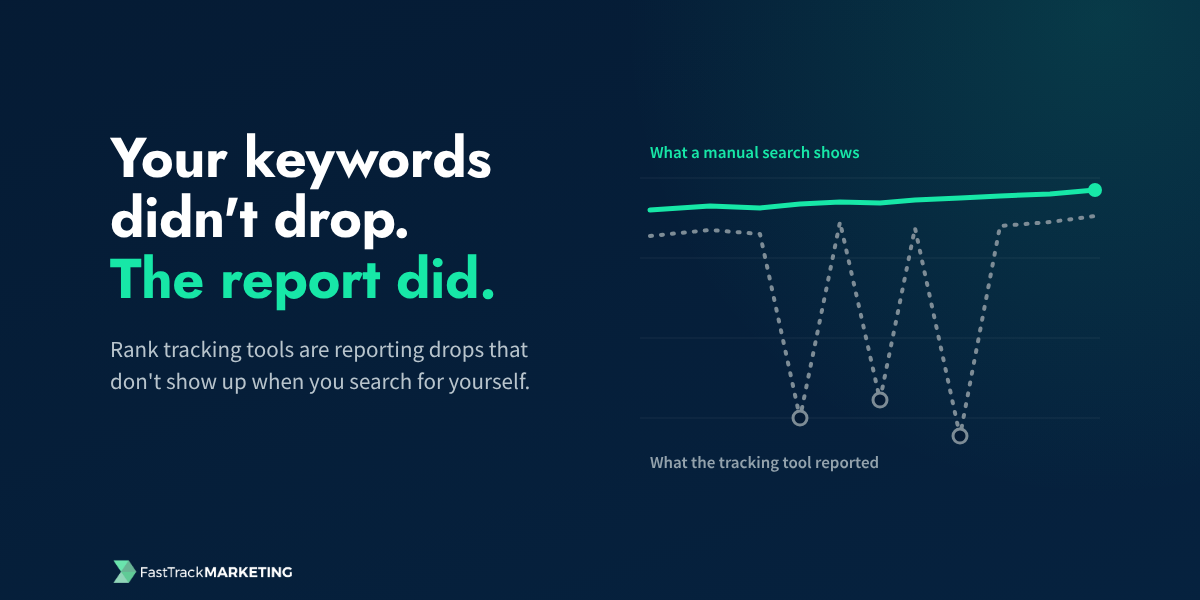
Picture this. You open your monthly SEO report and one of your best keywords, something like “LASIK surgeon” plus your city, has fallen from the top three down to somewhere around position 40. So you open Google, type in the exact same search, and there you are. Still in the top three, exactly where you’ve been for months.
That gap between what the report says and what Google actually shows is what a lot of the SEO world has been dealing with this fall. We’ve seen it in Moz and we’ve seen it in SE Ranking. The tools report a keyword as dropped, and when we search it by hand the ranking hasn’t moved. The keywords are fine. The reporting is what’s broken.
Why the tools are getting it wrong
A rank tracker doesn’t watch Google the way a person does. It runs searches automatically, thousands of them a day, looks at where each website lands, and writes that position down. Your report is built from whatever those automated searches got back.
Starting around mid-September, Google began treating those automated searches differently. Some got blocked. Others got back a page that looked like a normal set of search results but had the usual websites swapped out for different ones. The tool had no way of knowing it was looking at a fake page, so it recorded your website as missing, or way further down than it really is, and that number went straight into your report.
A real patient searching from their phone never saw any of that. They saw the same results they’ve always seen.
Google hasn’t publicly explained why it’s doing this. The common view in the industry is that it’s cracking down on automated scraping in general, mostly aimed at AI companies and data resellers, and rank tracking tools got caught in the middle.
The tool companies have confirmed it
This isn’t a theory. Ahrefs called it “an industry-wide issue impacting many companies in our space” and estimated that 5 to 20 percent of results were affected, depending on where the data came from. SE Ranking posted about missing keyword positions on its status page and said in mid-October that about 2 percent of tracked results were still affected. Semrush confirmed the problem as well, though it said the impact on its users was limited. SISTRIX, AccuRanker and several others have published notes on how they’re trying to filter out the bad data.
So if your report has shown keywords disappearing or falling off a cliff since September, there’s a real chance that’s the tool, not your website.
How to see what’s actually true
The fastest way to tell is the one we’ve been relying on most. Search for it yourself. Open a private or incognito window so your own browsing history doesn’t change the results, search the way a patient in your area would, and see where you actually show up. If the report says position 40 and you’re looking at yourself near the top of page one, you have your answer.
That’s exactly what we’ve been doing for every one of our clients since this started. We take the keywords the tools flag as dropped, search them manually, and compare what we see against what was reported. Over and over, the rankings are right where they were and the report is the thing that’s off.
Google Search Console is the other good check if you have access to it. It’s built from what real people saw when they searched, not from automated checks, so it isn’t affected by any of this. If the tracker says a keyword crashed but Search Console shows impressions and clicks holding steady for that same stretch, the crash didn’t happen.
And keep an eye on the front desk. If calls, form fills and consultation requests are steady, patients are finding you just fine, whatever the report says.
The one thing we’d really caution against is reacting to the report alone. Rewriting a page, changing your ads or pulling budget because a tool said a keyword dropped is how a reporting glitch turns into an actual problem.
Are you seeing this too?
We’d love to hear from anyone else dealing with it. Which tool you use, what it’s been showing, and whether it matched what you found when you searched for yourself. The more people compare notes, the easier it is to separate the real movement from the noise.
If you’re staring at a report right now and aren’t sure what to believe, grab some time with Jonna and we’ll look at it with you.